Run your whole GTM motion from the terminal
Product marketing is mostly structured thinking plus a lot of artifact production. That's exactly what a plugin of 45 skills, grounded in your product context and routed by an orchestrator, is good at. A tour of the workflow.
Every product launch produces the same mess: a positioning doc here, a messaging doc there, a pricing spreadsheet, a competitive battlecard, a deck for the sales team, a one-pager for the website, and a Slack thread where half the real decisions actually live. Each one starts as a copy of the last, and within two weeks they disagree with each other.
If you changed your positioning today, how many separate documents would you have to hunt down and update by hand?
The artifact sprawl problem
The number is usually somewhere between five and fifteen. That's the artifact sprawl problem: the same handful of strategic decisions — who it's for, what it replaces, why it wins, what it costs — get re-typed into a dozen formats, owned by different people, living in different tools.
Sprawl isn't a tidiness issue. It's a correctness issue. When the sales deck says one thing and the website says another, the gap doesn't show up in a review — it shows up in a lost deal.
- Positioning lives in a doc nobody opens after week one.
- Messaging gets copied into the homepage and then edited only on the homepage.
- The deck is a fork of a fork of last quarter's deck.
- Pricing is a spreadsheet the deck screenshots once and never re-checks.
Why everything drifts
Documents drift because the cost of keeping them in sync is paid by a human, manually, every time anything changes — and that cost is always higher than the perceived cost of letting one doc go stale. So they all go stale, just at different rates.
The fix isn't discipline. Discipline doesn't scale, and it's the first thing to go under launch pressure. The fix is structural: make the artifacts derive from one source instead of being maintained in parallel.
One source, regenerated
The alternative is the pattern every modern toolchain already uses: keep the truth in one structured place, and generate every surface from it. Code generates its own docs. Design tokens generate themes. Your launch artifacts can work the same way.
In PMM OS, the truth is a single structured file. From it, the plugin regenerates an interactive HTML hub, a clean markdown mirror of every section, and a slide deck you can export to PowerPoint. Change the positioning once and all three update — because they were never separate documents in the first place.
- Capture the strategy as structured content, not prose scattered across tools.
- Generate the interactive kit, the markdown, and the deck from it.
- Edit in the kit; every output regenerates from the same source.
- Share one link instead of attaching five files that will disagree by Friday.
What the launch kit actually is
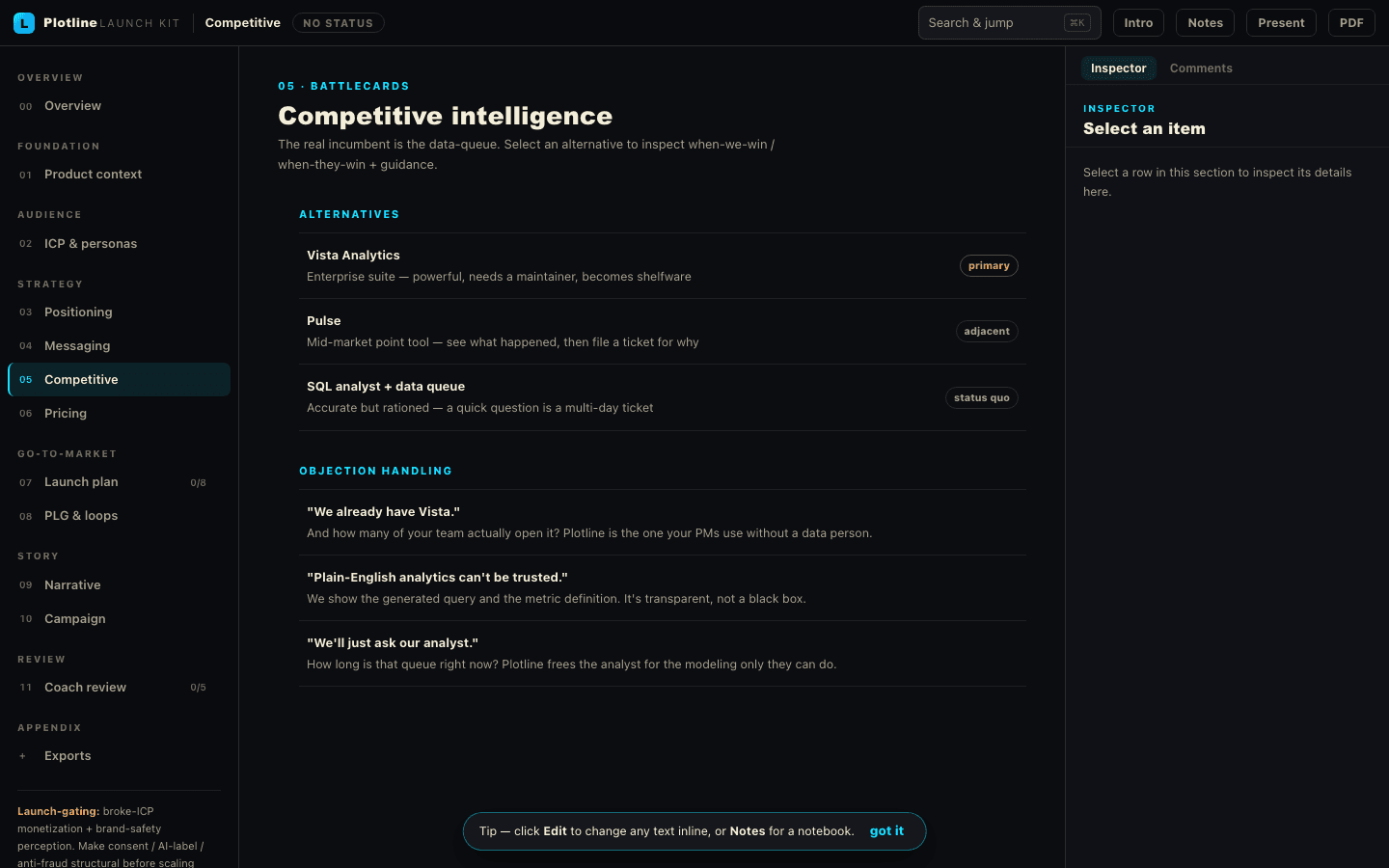
The interactive kit is a single self-contained HTML app — a left sidebar of sections, a main workspace, and an inspector — with a command palette and a present mode for when you need to walk a room through it. It opens in any browser with no build step and no dependencies.
Crucially, it's editable. Every block is inline-editable, you can insert blocks with a slash menu, convert a block from one type to another, and leave comments anchored to specific text. Those edits write back to the one source — so the kit isn't a read-only export, it's the working surface.
Putting it into practice
Start with your next launch, not a retroactive cleanup. Run the positioning and messaging skills, let them populate the kit, then edit it live with the people who own the launch. When pricing shifts the week before go-live — and it will — you change it once and re-export the deck instead of reconciling five files at 11pm.
The goal isn't a prettier document. It's removing the manual sync tax entirely, so the deck, the site, and the docs can't disagree.